Additional Info
The fact that they were able to make a 140-meter fiber battery shows that “there’s no obvious upper limit to the length. We could definitely do a kilometer-scale length,” he says. A demonstration device using the new fiber battery incorporated a “Li-Fi” communications system — one in which pulses of light are used to transmit data, and included a microphone, pre-amp, transistor, and diodes to establish an optical data link between two woven fabric devices.
“When we embed the active materials inside the fiber, that means sensitive battery components already have a good sealing,” Khudiyev says, “and all the active materials are very well-integrated, so they don’t change their position” during the drawing process. In addition, the resulting fiber battery is much thinner and more flexible yielding an aspect ratio, that is the length-to-width fraction, up to a million, which is way beyond other designs, which makes it practical to use standard weaving equipment to create fabrics that incorporate the batteries as well as electronic systems.
The 140-meter fiber produced so far has an energy storage capacity of 123 milliamp-hours, which can charge smartwatches or phones, he says. The fiber device is only a few hundred microns in thickness, thinner than any previous attempts to produce batteries in fiber form.
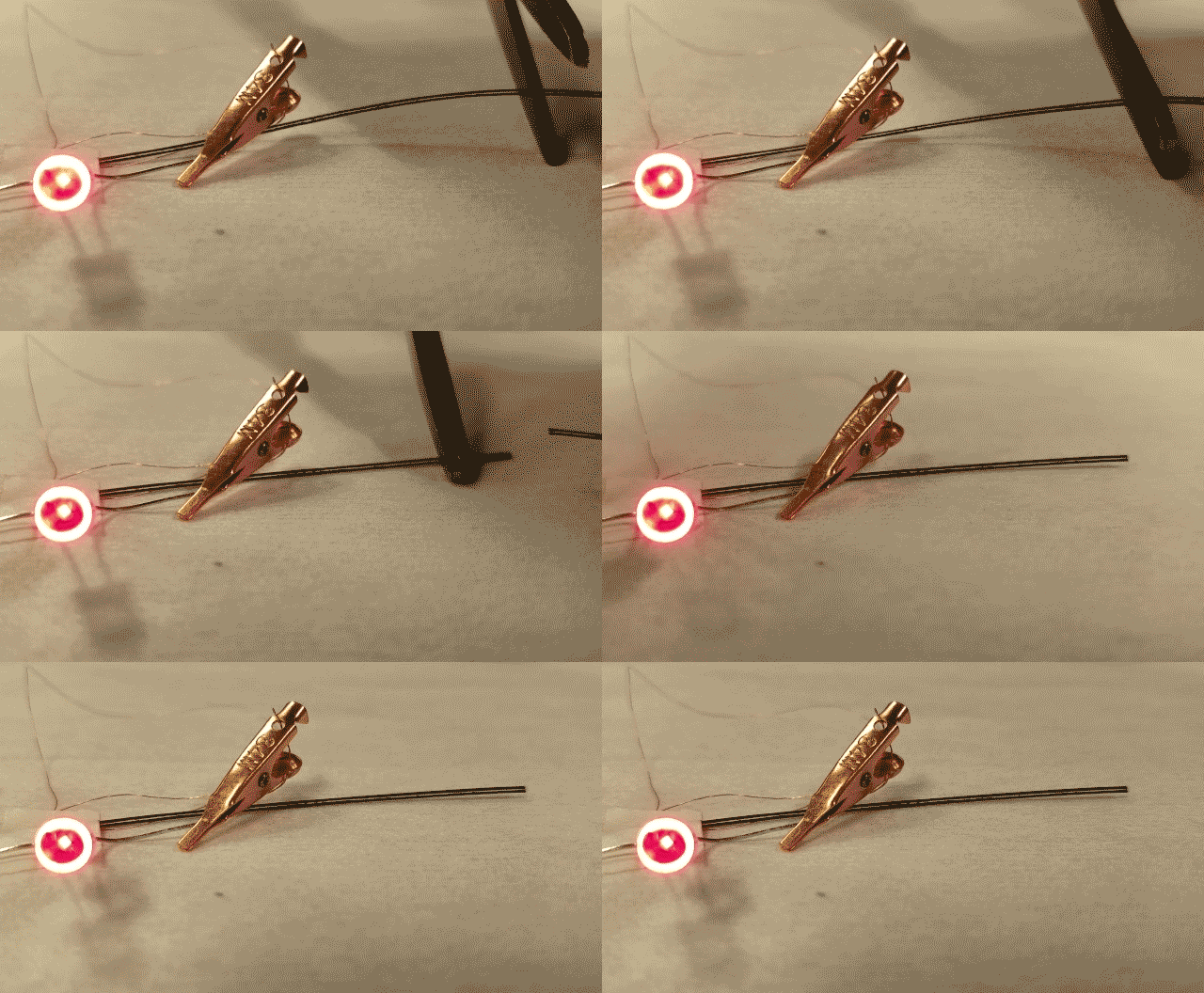
“The beauty of our approach is that we can embed multiple devices in an individual fiber, Lee says, “unlike other approaches which need integration of multiple fiber devices.” They demonstrated integration of LED and Li-ion battery in a single fiber and he believes more than three or four devices can be combinded in such a small space in the future. “When we integrate these fibers containing multi-devices, the aggragate will advance the realization of a compact fabric computer.”
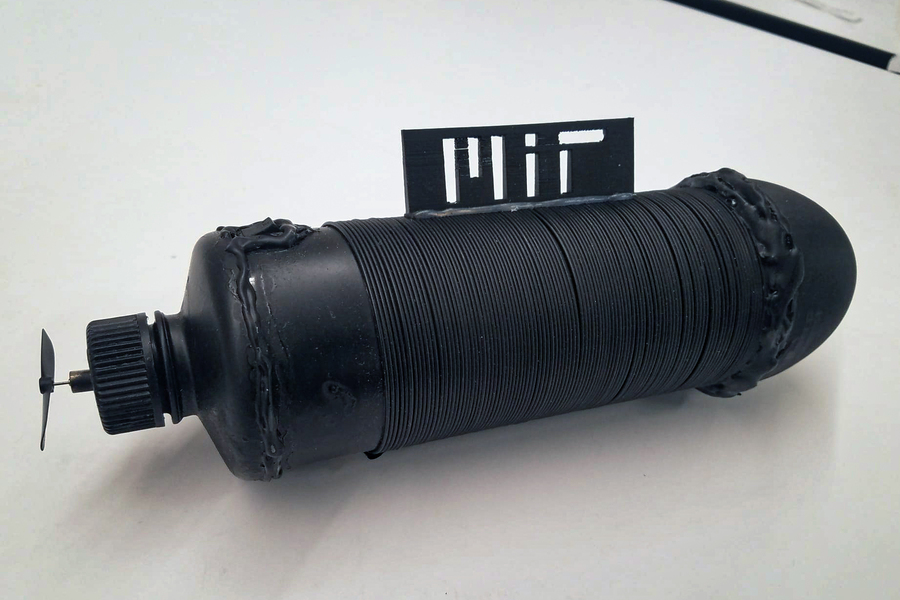
“This is the first 3D printing of a fiber battery device,” Khudiyev says. “If you want to make complex objects” through 3D printing that incorporate a battery device, he says, this is the first system that can achieve that. “After printing, you do not need to add anything else, because everything is already inside the fiber, all the metals, all the active materials. It’s just a one-step printing. That’s a first.”
That means that now, he says, “Computational units can be put inside everyday objects, including Li-Fi.”